Quantum Harvest
How to keep three overlapping farm timelines from collapsing into one another.
Welcome to the Chrono-Agricultural Revolution
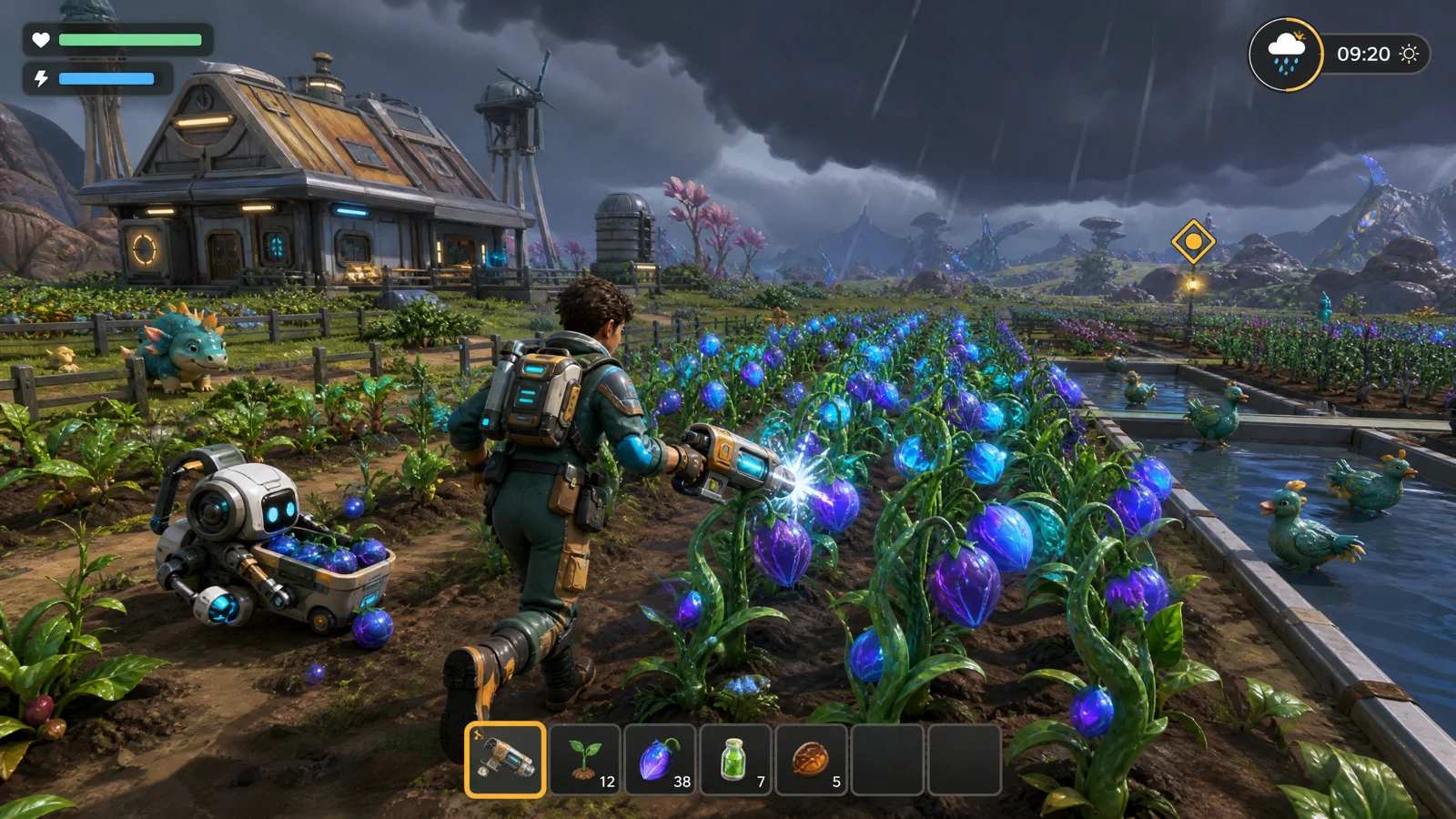
Get ready, strategists and digital farmers alike, because the fields of tomorrow have finally arrived on our screens! Quantum Harvest drops you straight into the most fiercely competitive agricultural simulation we have seen in years, taking the cozy farming genre and injecting it with the high-stakes adrenaline of a grand strategy presentation. In this brilliant new title, you are not merely waiting for the rain to fall or the sun to shine; you are actively managing seedlings, mature crops, and massive harvests across entirely overlapping time lanes. It is a bold premise that demands both foresight and flawless execution, challenging players to manipulate the temporal flow of their fields while simultaneously outmaneuvering rival farming conglomerates.
From the moment you load into your first match, the energy is palpable. The game wastes no time in introducing its core hook: the ability to shift agricultural phases across different timelines. You might be planting seeds in the present, while simultaneously managing a sudden frost in a past timeline to ensure your future harvest remains pristine. This dynamic creates a thrilling, fast-paced environment where every decision ripples across the continuum. It is not just about what you grow, but when you grow it, making every second of the match a frantic, deeply rewarding puzzle of resource allocation and temporal management.
Mastering the Overlapping Time Lanes
The true genius of Quantum Harvest lies in its unusual planning horizon. Unlike traditional strategy games where turns progress linearly, here you are constantly balancing multiple active timelines. Your farm exists in a state of flux, with overlapping lanes representing different seasonal states. Managing these lanes requires an acute awareness of your team's roles and the ability to pivot strategies on the fly. One player might be dedicated entirely to chronal-fertilization in the early spring lane, while another is aggressively harvesting in the late autumn lane to secure market dominance before the temporal window closes.
This level of coordination is heavily supported by the game's highly readable seasonal changes. Despite the chaotic nature of managing multiple time streams, the visual cues are remarkably clear. The shifting color palettes—from the vibrant, hopeful greens of a newly unlocked spring timeline to the deep, golden hues of a mature autumn harvest—ensure that you always know exactly which temporal lane you are interacting with. It is a masterclass in visual design that keeps the high-speed strategy from devolving into an unreadable mess, allowing teams to execute complex, multi-lane agricultural maneuvers with precision and style.
The Competitive Ecosystem and Team Dynamics
When it comes to multiplayer, Quantum Harvest truly shines as an energetic, competition-ready spectacle. The team roles are distinctly defined, forcing players to specialize and communicate effectively. You have your Seeders, who manage the initial timeline investments; the Chrono-Tenders, who manipulate the flow of time to accelerate growth or delay disasters; and the Harvesters, who execute the final, critical gathering phases. This division of labor creates intense, highly communicative gameplay sessions where a single missed callout can lead to a temporal crop collapse. It is the kind of game that is as thrilling to watch as it is to play, making it a prime candidate for competitive strategy play.
However, the pacing can occasionally feel overwhelming for newcomers. The sheer volume of information presented at any given moment requires a steep learning curve. You are not just monitoring your own fields, but also keeping a close eye on the overlapping lanes of your competitors, ready to sabotage their timelines or defend your own from chronal interference. When a well-coordinated team successfully pulls off a synchronized multi-lane harvest, the rush is incredible, cementing the game's status as a top-tier competitive experience that rewards deep, strategic mastery over its complex mechanics.
Evaluating the Harvest: Final Thoughts
Despite its many triumphs, Quantum Harvest is not without its flaws. The most glaring issue is the dense calendar screen, which serves as the primary interface for managing your timelines. While the in-game seasonal visuals are crisp and readable, the overarching UI can become a tangled web of overlapping dates, crop yields, and temporal shifts. During high-stakes matches, trying to parse this dense screen can lead to frustrating misclicks and strategic errors. Additionally, the solo experience is hampered by uneven AI rivals. The computer-controlled opponents oscillate wildly between baffling incompetence and omniscient temporal mastery, making offline practice sessions feel inconsistent and occasionally unfair.
Yet, even with these limitations, the game earns a solid 7.9 out of 10. The core loop of managing seedlings and mature crops across overlapping time lanes is simply too innovative and engaging to ignore. It pushes the boundaries of what a farming strategy game can be, delivering a high-octane experience that demands your full attention. For those willing to brave the steep learning curve and navigate the occasionally cluttered interface, there is a deeply rewarding, highly competitive harvest waiting to be reaped.
Strengths
- Unusual planning horizon that redefines strategic foresight.
- Distinct, highly synergistic team roles for competitive play.
- Highly readable seasonal changes despite complex timelines.
Limitations
- Overly dense calendar screen complicates high-speed UI navigation.
- Uneven AI rivals create an inconsistent solo practice environment.
Disclaimer: Quantum Harvest, its developing studio, and this review are entirely original fictional concepts created exclusively for bexuqaro.info. This article does not represent a real commercial product or actual software.
A clear score with visible reasoning.
Controls, structure, presentation and long-term value inform the final number.